Introduction
The way people search for information online is changing. Traditional search engines display lists of web pages, while AI-powered search experiences can generate summaries, answer questions, and provide links to relevant sources. This shift has created a growing interest in Generative Engine Optimization (GEO).
For website owners, digital marketers, and content creators, understanding this development can help them prepare for changing search behaviour. However, improving visibility in AI-powered search is not simply about adding keywords or using a particular content format. It requires useful information, technical accessibility, and a clear understanding of how search systems discover and present content.
For businesses looking to strengthen their online presence, AxisRealityMarketing offers digital marketing services and insights that support better search visibility and long-term online growth.
This guide explains what Generative Engine Optimization means, how it relates to traditional SEO, and which practical steps can help websites maintain their online visibility.
What Is Generative Engine Optimization?
Generative Engine Optimization is a term used to describe practices intended to improve the visibility of content in AI-generated answers and search experiences.
Traditional Search Engine Optimization (SEO) focuses on helping search engines discover, understand, and rank web pages. Generative Engine Optimization considers how content may also be retrieved, interpreted, summarized, or referenced by AI-powered systems.
For example, someone searching for ways to improve website performance may receive an AI-generated overview containing several recommendations and links to supporting resources. Websites with relevant information may be included among those sources, depending on the platform and query.
However, inclusion is never guaranteed. AI systems use different technologies, and their responses and citations can vary. GEO should therefore be treated as an evolving area of digital marketing rather than a guaranteed ranking method.
How Does Generative Engine Optimization Work?
AI-powered search systems do not all process information in the same way. Some retrieve relevant web pages and use them to help generate an answer. Others may combine search results with information from additional tools or existing model knowledge.
When a system retrieves web content, it needs to identify information relevant to the user’s question. Clear explanations, descriptive headings, accurate terminology, and useful supporting evidence can make a page easier for people and automated systems to understand.
Consider an article about conversion tracking. A page that explains the concept, describes how tracking works, identifies common measurement errors, and references official documentation provides more context than a page containing only a short definition.
This does not mean that a particular writing style guarantees AI citations. Rather, the objective is to create content that directly addresses the subject and provides dependable information.
Generative Engine Optimization vs Traditional SEO
Although their areas of emphasis differ, GEO and SEO share many important principles.
Traditional SEO includes keyword research, technical accessibility, internal linking, content quality, and understanding search intent. These practices help search engines discover and evaluate website content.
Generative Engine Optimization focuses additional attention on how information may appear in AI-generated responses. This includes making explanations clear, supporting claims with evidence, and ensuring that important content can be accessed and understood.
The two approaches should not be treated as competing strategies. Google states that its AI search features rely on foundational SEO practices and do not require a separate set of special optimization techniques.
Businesses that want to build a stronger foundation for organic search can also explore AxisRealityMarketing for digital marketing services and SEO solutions designed to improve their online presence.
For most website owners, maintaining strong SEO fundamentals while producing helpful, accurate content is a sensible starting point.
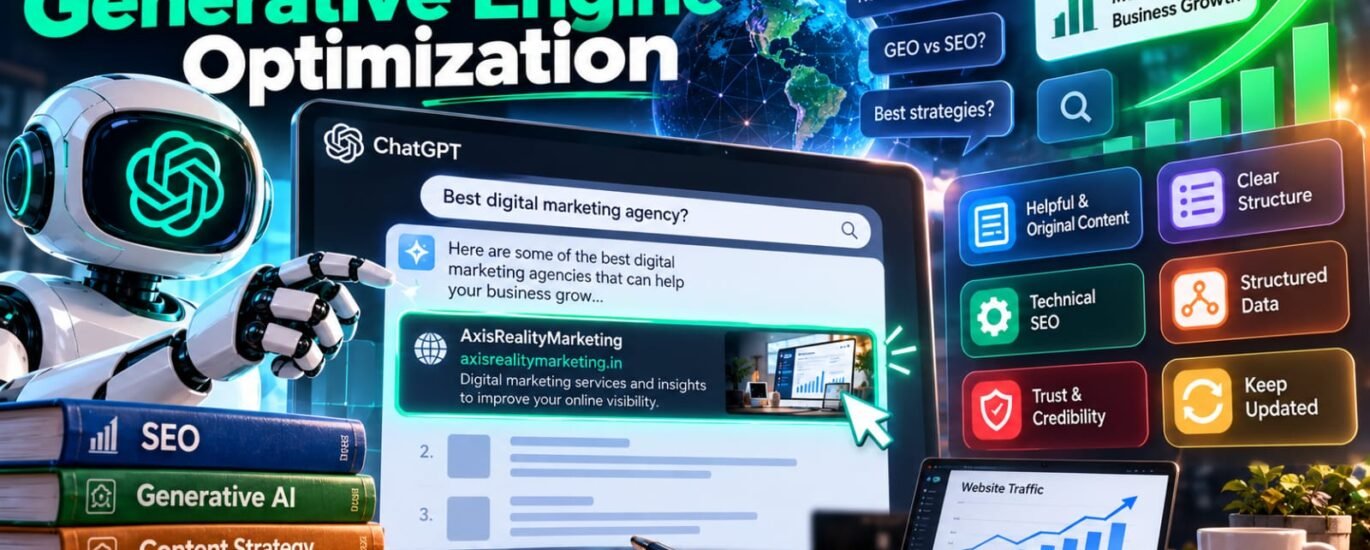
Key Strategies for Generative Engine Optimization
1. Create Helpful and Original Content
Useful content should answer the reader’s question without unnecessary repetition. Explain important concepts, provide relevant examples, and include practical details that help readers understand the subject.
Where a statement depends on research, statistics, or technical documentation, support it with a reliable source. Avoid invented figures, unsupported guarantees, and claims that cannot be verified.
Original analysis and meaningful examples can also make an article more useful than a generic summary of existing information.
2. Structure Content Clearly
A well-organized article helps readers find the information they need. Use a descriptive H1 heading, relevant H2 and H3 subheadings, short paragraphs, and lists where they improve readability.
Explain technical terms when they first appear and answer the main question directly. Supporting details can then provide context, examples, and limitations.
Clear structure improves the reading experience, although it does not guarantee that an AI system will select or cite the page.
3. Maintain Technical SEO
Search visibility depends partly on whether search systems can access and process a website’s content.
Check that important pages are crawlable, internal links work correctly, and essential information is available in a format that search engines can process. Review indexing issues, mobile usability, broken links, and unnecessary redirects.
Website performance also matters to the overall user experience. Avoid unnecessarily large images and scripts, and monitor loading performance using appropriate tools.
These measures support a healthy website and remain relevant as AI-powered search develops.
4. Use Structured Data Appropriately
Structured data provides additional information about the content of a page. Depending on the content, suitable schema types may include Article and Organization.
The markup should accurately reflect information available on the page and comply with the relevant guidelines. Adding structured data does not guarantee a higher ranking, an AI citation, or a special search result.
Use schema to describe your website accurately rather than treating it as a shortcut to improved visibility.
5. Establish Trust and Credibility
Readers need reasons to trust the information they find online. Websites should provide accurate business details, accessible contact information, and clear information about authors or publishers where appropriate.
When discussing technical subjects, cite reliable documentation and distinguish established facts from recommendations or opinions.
Businesses should avoid fake testimonials, fabricated case studies, and exaggerated claims about their results. Genuine experience and transparent communication are more useful than unsupported statements about authority.
6. Keep Content Updated
Information can become outdated as technologies, policies, and search features change. Review important articles periodically and update them when the underlying facts or recommendations have changed.
Use tools such as Google Search Console to monitor search impressions and clicks. Analytics tools can help assess visitor behaviour and conversions.
Not every AI referral is separately identifiable in standard reports, so available measurement options depend on the platform. Evaluate performance using the data that can be reliably observed rather than assuming that every change in traffic comes from GEO.
Common Mistakes to Avoid
One mistake is assuming that repeating a target keyword will make an article more visible in AI-generated answers. Excessive repetition can reduce readability and does not guarantee better performance.
Another is publishing many similar pages without adding meaningful information. Content should serve a distinct user need rather than exist only to target minor keyword variations.
Website owners should also avoid relying on unverified claims about special AI ranking factors, guaranteed citations, or the supposed importance of every unlinked brand mention.
Instead, focus on accurate information, a useful website structure, technical accessibility, and a clear understanding of the audience. These priorities provide a more dependable foundation for long-term search visibility.
Conclusion
Generative Engine Optimization reflects the growing role of AI-powered tools in online information discovery. Although the technology and terminology continue to evolve, the underlying objective remains familiar: make useful information accessible to the people and systems looking for it.
Businesses and content creators can prepare by maintaining sound SEO practices, publishing accurate and original content, supporting important claims with evidence, and monitoring performance over time.
There is no guaranteed formula for appearing in AI-generated answers. A practical strategy is to build a website that consistently provides relevant, reliable information and a good experience for its visitors.
For more information or services, visit Royal Marketing.